

In an era where technological advancement seems limitless, a crucial question remains: are we solving the right problems? Lorenz Fellow Aishwarya Khanduja has tackled this fundamental question in her groundbreaking research, "Redefining Technoscience Priorities: Framework for Identifying and Mapping Critical Human Problems."
Her work comes at a critical time when the tech industry's focus has been increasingly scrutinized for its potential biases and oversights in problem selection. Khanduja's research provides a rigorous framework for identifying and prioritizing global challenges worthy of scientific and technological attention.
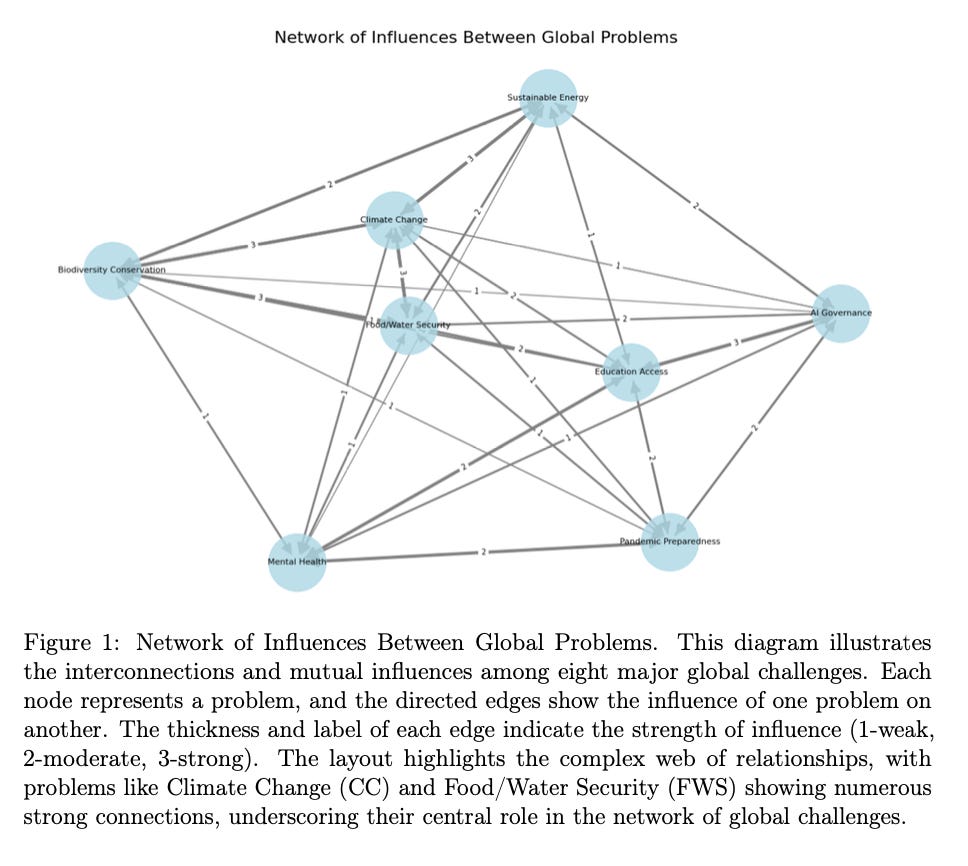
Network of Influences Between Global Problems. This diagram illustrates the interconnections and mutual influences among eight major global challenges. Each node represents a problem, and the directed edges show the influence of one problem on another. The thickness and label of each edge indicate the strength of influence (1-weak, 2-moderate, 3-strong). The layout highlights the complex web of relationships, with problems like Climate Change (CC) and Food/Water Security (FWS) showing numerous strong connections, underscoring their central role in the network of global challenges.
We sat down with Aishwarya Khanduja, managing partner at The Analogue Group, to understand how this project came about.
"The genesis of this research was a recognition that the problems we choose to solve with technology often reflect a narrow perspective," Khanduja explained. "I wanted to create a framework that could help ensure we're addressing issues that matter to all of humanity, not just a select few."
The study introduces a novel mathematical approach to analyzing global challenges, using network analysis to map the complex relationships between different problems. This methodology reveals how issues like climate change, food security, and education access are deeply interconnected.
"What's fascinating is how these problems form a complex web of mutual influences," Khanduja noted. "For instance, I found that addressing education access has surprisingly strong ripple effects across other challenges, including AI governance and mental health."
Her research employed sophisticated network analysis techniques to quantify these relationships. She developed a comprehensive matrix that scores the influence of each problem on others, using a scale from 0 (no influence) to 3 (strong influence). This mathematical rigor sets her work apart from previous attempts to map global challenges.

Influence Matrix of Global Challenges. This matrix quantifies the strength of relationships between eight major global challenges, where entries represent the influence of row elements on column elements. Values range from 0 (no significant influence) to 3 (strong influence), with '-' indicating no direct relationship. Higher values and darker shading indicate stronger influences between challenges. For example, Climate Change (CC) has strong influences (3) on Food/Water Security (FWS), Sustainable Energy (SE), and Biodiversity Conservation (BC), while having moderate influence (2) on Mental Health (MH).
The results were revealing. "I discovered that some problems, particularly climate change and food/water security, act as central nodes in this network," Khanduja shared. "This means that progress - or lack thereof - in these areas can have cascading effects throughout the entire system of global challenges."
Key findings from her network analysis include:
Climate change shows strong influences on food/water security, sustainable energy, and biodiversity conservation
Education access has unexpected strong connections to AI governance and mental health
Pandemic preparedness strongly influences mental health outcomes
Biodiversity conservation has critical links to both climate change and food security
The implications of this research extend far beyond academia. Her framework provides a robust approach for policymakers and technologists to prioritize efforts and resources. "I'm not just identifying problems," Khanduja emphasized. "I'm providing a roadmap for understanding how these challenges interact, which can inform more effective intervention strategies."
Looking ahead, Khanduja sees her framework as a starting point for more inclusive and effective problem-solving in technology and science. "My hope is that this work will help shift the focus of technological innovation toward addressing the most critical challenges facing humanity as a whole," she concluded.
The research marks a significant step toward decolonizing and degendering technoscience, offering a more equitable approach to deciding which problems deserve our attention and resources. As we continue to face increasingly complex global challenges, frameworks like this become essential tools for ensuring our technological progress serves the needs of all humanity.